
Many of us who end up in a leadership role at a nonprofit organization never intended, nor consciously desired to be there. Often, people are drawn to a cause and find themselves contributing in meaningful ways. And their role grows over time, until they find themselves in a position of leadership at the organization, not by any intentional design or aspiration, but by default. As the Cabiri (a nonprofit organization where I am a founding member and now the Managing Director) approaches its 20th anniversary a month from now, I find myself reflecting on how I got here and what the future may hold. I hope that by sharing some of my world, it will bring new perspective and understanding to the countless others who are doing this work all over the world. Our nonprofit leaders are a resource more precious than gold – they are worth protecting and cherishing.
My History – The Short Version
In 1999, I was 23. The ink on my two bachelor’s degrees was less than a year old, and I’d been living on my own in Seattle for 4 years. A veteran of the performing arts world (I started in musical theatre at age 5), I was looking for something new to put my creative energy into as an adult. I discovered street theatre and performance art and felt strongly drawn to its visceral, honest, powerful potential.
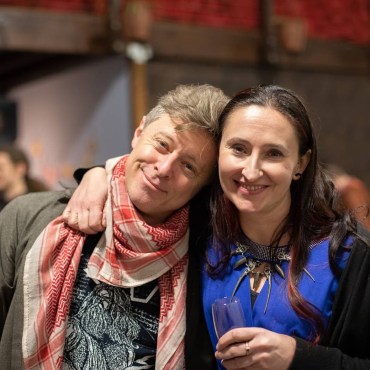
I met John Murphy, Founder and Artistic Director of the Cabiri on a sidewalk in March of 1999 and we, along with 3 other performing artists, formed the troupe shortly thereafter. Myth and folklore was always the focus of our work – movement, props, costumes, and music were all informed by the stories that inspired us.
After a year or so of performing on street corners and outdoor festivals, we decided it was time to legitimize our work by becoming a nonprofit organization and applying for tax exempt status from the IRS. Things moved quickly after this – in November, 2000 we became legally incorporated in Washington State and in 2001, we were granted tax exempt status. I filled out the application paperwork for both of these milestones, with the help of an attorney friend. We opened a bank account at the now-extinct Seafirst Bank. I kept the checkbook in order. We started applying for grants, and were quickly successful at receiving a bit of funding for our performances. I was our primary grant writer, self-taught. My title in the Cabiri was “Secretary / Treasurer” for many years. And so began my gradual climb into a leadership role in the organization. These invisible yet essential tasks had to be done by someone, and no one else was stepping forward to take them on. Leadership by default.
At some point several years into our history, John and our Board of Directors gave me a new title – Managing Director – to honor the amount of work I was doing. Elevation and acknowledgment felt good, but I didn’t know how to be a leader. I came into the organization driven by my passion for storytelling and performance, not to make business decisions, interact with vendors, troupe members, and volunteers, and handle interpersonal dealings with other artists and organizations from a position of authority. And I certainly never imagined myself managing a six-figure annual budget, a dozen staff members, volunteers, and a cultural arts facility.
The Lady Behind the Curtain
Much of the work I do for the Cabiri (entirely as a volunteer) is invisible. A small sampling of the ongoing tasks I oversee includes filling out annual insurance renewal applications, running payroll each month, paying all our bills, filing our annual tax returns, negotiating contracts and leases, applying for and managing grants, managing the budget, updating both our web sites, responding to emails, taking out the trash at the studio, managing our aerial curriculum and instructors, creating and updating the monthly studio schedule, interfacing with renters, teaching 3-5 classes each week, performing in the Cabiri, and interfacing regularly with our social media, marketing, and technical personnel and our board of directors. The cost of failure or ineptitude in most of these areas is very high. Some of the items on that list are thing I enjoy doing; the majority of those items are compulsory.
Did I mention that I also work full time as a paralegal? Are you seeing that list and thinking that a lot of these jobs really should belong to a bookkeeper, a lawyer, a studio manager, and a janitor? I agree completely. But, given how small we are and how little resources we have, all of these responsibilities rest on my shoulders, along with a couple of other dedicated, competent, trustworthy people. And so my leadership style is largely a byproduct of my workload, i.e. there isn’t much room for things that don’t add value.
Why don’t I delegate more? This is a question I hear often. Delegation of critical functions is a risky proposition that can have catastrophic effects if it doesn’t go well. A local arts council got into hot water with the IRS after a series of bookkeepers came and went and knowledge and responsibilities became diluted over time until eventually no one was performing the required tasks. Delegation of critical functions is also a time-consuming process, often taking months or even years to fully realize. It is very uncommon to have a volunteer with the proper skill set and dedication cross our path and choose to stay involved for the months or even years needed to successfully take on a critical function in the organization. It is often more efficient and less risky to maintain the status quo. (I am happy to report that our newest work study volunteer has taken over the task of keeping the studio plants alive and taking out the trash on Wednesday nights. Small victories are worth celebrating.)
I am inspired by people who work hard, who bring depth and richness to their work, and who are proactive about what can be done to make improvements and add value to the organization. I cherish people who communicate clearly and often, who collaborate and keep me informed, who understand the importance of my role and its many facets. Reliability, consistency, directness, and honesty are very important to me. When time, energy, and resources are scarce, I seek to find allies who are assets. I intentionally create distance from individuals and organizations who do not add value, who create negativity, chaos, and uncertainty. Every decision I make as a leader serves to support, protect, and help the organization grow and expand.
The Price of Leadership

Being the boss of anything can be a pretty thankless job. (It can also be deeply fulfilling and incredibly rewarding, but that is not the focus of this article.) When something isn’t right at an organization or someone has a bad experience, the leaders are blamed – sometimes rightly so, other times at no fault of leadership. Conversely, when everything is running smoothly and life is good, the leadership is rarely thanked or acknowledged. It is easy to sit back and enjoy the beautiful fields of flowers before us (or perhaps even pick or stomp on the flowers) without considering the farmer who labored to create it. Stepping into a leadership role is like stepping in front of a firing squad of critics. Leaders put themselves into the public eye, and are often on the receiving end of endless unsolicited suggestions and advice on how to run one’s business. It is a role that truly tries one’s patience on a daily basis.
Managing human beings (both volunteers and employees) is perhaps the most challenging aspect of leadership, and rife with paradoxical expectations. We humans are special snowflakes. The approach that works well for one person is dreadfully off putting and perhaps even rage-inspiring for another person. Leaders should be fair and consistent, yet also incredibly flexible. (What?) Leaders are expected to adapt their approach and communication style to accommodate whichever snowflake needs their attention today. We can’t simply work to understand ourselves, our challenges, our shortcomings; we must also become masters of everyone who works for us, and behave accordingly. We aren’t allowed to have a bad day or be grumpy or short with someone. We aren’t allowed to get angry or have a meltdown in public. We must extend understanding, compassion, and forgiveness when people make mistakes, even if no apology is offered and no responsibility is taken by the offending party. Yet we apologize often and thank people for their feedback, even when it stings so hard we have to fight back tears. We aren’t allowed to arrive late or forget something important, because all eyes are on us. When someone doesn’t follow policy and we cite policy in a conversation with them, we are viewed as impersonal, unkind, and bureaucratic. If we are too gentle and subtle with feedback, it often goes unheard. When expectations aren’t communicated clearly enough, people become frustrated. When expectations are communicated too often and too explicitly, we are resented as micromanagers. Leaders who make an effort to connect on a personal level are seen as warm by some and nosy by others. It is impossible to be the perfect boss to every person. When there is a problem or challenge and a difficult conversation must be had, guess who’s going to be in that room trying to sort it out the best she can every single time? Yup, it’s me. Thankfully I’m almost never in that room by myself. The support and compassion of my co-leader John makes all of this infinitely more bearable.
And so I try my best, and I acknowledge my many imperfections. My work style is task-oriented, goal-focused, logical, and direct. I prefer to address issues directly and quickly and shine light on situations in order to move forward. I am not afraid to take action and make changes in order to protect the organization and the studio and to serve the ultimate goal: added value. I am not afraid to speak up when something isn’t working and I am never shy about giving feedback. But I sometimes forget to say thank you and show appreciation. My direct, linear, fact and task-oriented approach can be be perceived as cold, uncaring, and harsh. Slowing down, improving my patience, and learning to let the little things slide has been the focus of my personal development as a leader in the past few years. I listen more and ask questions instead of jumping to conclusions. I consciously strive to create opportunities for people and actively support their personal and professional growth as much as I can. I admit my mistakes and faults. I apologize often when I have misstepped and sometimes even when apologizing is just the right thing to do. I accept feedback and take it to heart without becoming defensive. I keep showing up each day and trying my hardest. And I still make mistakes, often.
Because of my workload and the weight of the responsibilities and expectations I carry, I live in a constant state of scarcity and the crushing pressure of obligations. That’s a heavy burden to bear. And it is a lonely existence. In the past few years and especially since we opened our studio, signs of stress are manifesting in my body. I have chronic insomnia, often finding myself wide awake at 3am (it’s my own personal witching hour) worrying about things. I have recently developed an occasional stutter when speaking. A year ago, I went to the doctor with chest pains which turned out to be “nothing,” i.e. no obvious physical cause. They still appear often, especially when my stress level is high. My hands sometimes shake. Nausea comes at times. Waves of vertigo and dizziness. I grind my teeth at night. Doctor visits have yielded no results – I’m healthy, with below normal blood pressure and absolutely no sign of disease. There are days when I wonder if it is more than I can bear. I am not sure what the breaking point looks like because I haven’t gotten there yet, but I have tasted it for sure. Without the unwavering support of my partner and closest friends, it would have happened already.
If you’ve made it this far into this undeniably heavy article, my biggest suggestion to you is this: have patience with the leaders in your life.
If you have never been in charge of something, you cannot possibly imagine what it’s like to be in that role. No really, you can’t. Whether it’s your boss at work or the director of a nonprofit organization or a professor at school, they are carrying these burdens with them every single day. Be patient. Try not to judge them when they don’t get it right. They are humans too.
If you have time and energy to do more, thank them when things are going well; don’t take those times for granted. Find out how they like to be shown appreciation. Get them flowers on occasion, write them a thoughtful note, or bring them a little treat once in a while. Ask them if they need help, often. Even if they say no every time, it alleviates some of the loneliness to know that people are willing and interested in helping. Extend them respect, always, even when they are not at their best. Listen to what they have to say without interrupting. Give them space for their ideas and direction. Be open minded and receptive and honor their contributions. See if there are low level tasks you can do for them so they can focus on other things – like taking out the trash, vacuuming the studio, putting the mats away, refilling the paper towel dispenser.
Actions speak volumes for task-driven people like me. Show up, stand beside us, see what you can do to help. Put down your phone and look around to see what you can do to participate in creating, building, and sustaining the wonderful things in your world. Find ways to be selfless and generous every single day. I sometimes daydream that my organization would find 2 or 3 people with even just 25% of the time, energy, and competence I am willing to invest in our success. Can you imagine how much we could grow and thrive with more support? It is amazing to consider the possibilities if we weren’t in a constant state of scarcity. We could have a dedicated person to write grants and raise funds for us. We could have resources to pay our artists and teachers more. We could travel to teach and perform. We could afford the cushy toilet paper for the washroom.
But seriously, without the people who selflessly keep nonprofit organizations running, where would our world be? What would my organization be without my tireless dedication for the last two decades? Likely nonexistent. Nonprofit leaders are a precious resource worth protecting as fiercely as they work to protect their organizations. We must cherish every single one of them.

 myth.and.the.muse
Reblogged this on Ernie K Labs and commented:
Been there. LIved this. Done this. A job no one ever trains for, that engulfs them, and never lets them go. Charly is a wonderful human, and this deserves your time. You’ve probably done this, too. Maybe not with the same nouns, but definitely the same verbs.
LikeLiked by 1 person
I’m glad this resonated with you and thanks for sharing it. I appreciate your kind words so much, Ernie. Thank you for the support.
LikeLike