noun
- a person who is not conversant with a particular activity or skill.
- a person who lacks any sort of magical ability and was not born in a magical family.
An unfortunate incident tonight has inspired me to write this open letter to those of you who have perhaps never heard words like athame or widdershins and would have no idea what I mean when I say I’m “drawing down the moon,” “celebrating Mabon,” or “visiting my astral temple.” I have a lot of friends who I would say fall into the category of a muggle. When I say muggle, I mean people who don’t study or practice any form of occult studies, witchcraft, natural magic, etc. In other words, the majority of the people on this planet. I do not intend my use of it to sound derogatory in any way.
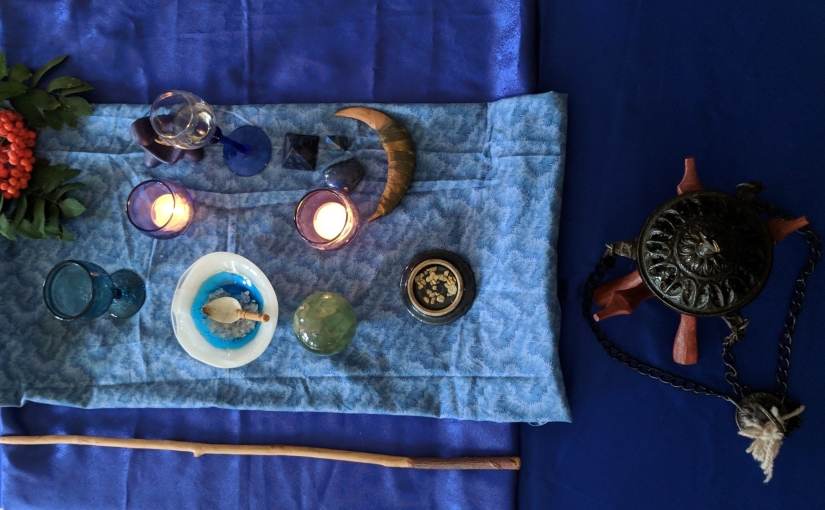
Tonight, at the conclusion of our Mabon (Autumn Eve) ritual, I packed up my ritual items and was within a few minutes of departing the space we had rented at the Unitarian Church for our rites. The ritual was lovely – several regulars and two guests who seemed to enjoy themselves. We celebrated the celestial balance that occurs on the equinox together. Another group was coming into the space after us, and they were quite anxious to set up their airpots of coffee and platters of lemon bars. A woman approached the center table, which had served as our main altar tonight, and decided the items there must be moved immediately. I was standing no further than 2′ from her, packing away the last of my items. She grabbed my ritual sword by the hilt with the intention of moving it, I think? I audibly gasped, quite loudly in fact and asked her to put it down immediately. I was absolutely mortified. No pagan or witch in their right mind would pick up someone’s ritual blade without express permission. Nor would most muggles with an above average level of common sense. She didn’t apologize.
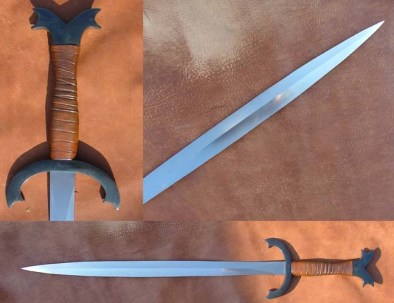 My ritual sword, the Slender Leaf Blade, was handcrafted by the late Jody Samson. I purchased it in approximately 2010 and it will be my ritual sword for the rest of my time upon this Earth. It is perfect in every way imaginable. When I received it, I performed a ritual on a celestially auspicious occasion, in order to cleanse and purify it and bind its energy to mine. I dressed it with ritual oils (the hilt only – not the blade) and it has been used on some of the most important occasions in my life. It travelled with me to Yellowstone twice – once for my yoking ritual, and again this summer. I used it in my ordination ritual last Autumn. It told me its name, which I will never utter aloud to another human. It has been handled by very, very few humans since its creation.
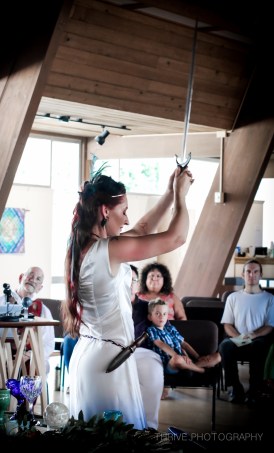
Ritually and magically, my sword represents the Air element, truth (it can be double-edged), and a conduit for intention and power. It is a symbol of strength, yang energy, and the willingness to defend and protect that which I hold sacred. Throughout the tarot, swords represent action, change, force, and freedom. On the rare occasion that I take it up in my hands, I am humbled by its shining surfaces, its weight, and its beauty. I feel honored to know its spirit and to share a connection with it. Perhaps you muggles are starting to understand why I was so upset to have my sword handled in such a callous manner tonight. I’m sure fellow heathens reading this are already feeling mortified on my behalf.
Now for a little bit deeper dive into the ways in which inanimate objects can become so closely connected to those of us who practice the arts magical.
To begin with, it is not true that the Gods dwell only in the Heavens, for all things are full of the Gods. – Iamblichus
“Iamblichus used the term “sunthemata” to describe theurgic tokens in the material world. These were items that bore some mark or characteristic of their divine nature. Sunthemata were said to be sown throughout nature by the Platonic Demiurge and served as reminders of the divine will and its connection to our lower level of reality… The sunthemata are physical manifestations of divine presence and will.” – excerpt from an article about theurgy on the Medieval Astrology website.
All of my ritual objects contain a spirit, an energy I work with everytime I perform ritual. I have spent years listening and working with these objects in order to learn their character and form a relationship with them. Once I have bonded with and adopted a physical item for ritual use, I prefer that others not handle it. There are exceptions, of course, but generally speaking the physical connection and handling of my ritual objects is exclusive to me in order to keep a clear and strong conduit of energy that is not complicated by others.
I have rites, herbs, salts, and sacred water for purification which I will surely employ in an attempt to right this wrong. But somehow the knowledge that this sacred object has been violated is harder to dispel. The older woman with greyish red hair is now part of the story of my sword, and I am not sure why or what her role is in the tale. I suspect it is very minor and perhaps merely a reminder that physical objects, even sacred ritual objects, are impermanent and ephemeral. It is also a reminder that there are a large percentage of people in the world who have very little understanding of sacred objects, even in a church environment.
Muggles who made it this far – please do your pagan and otherwise spiritual friends a favor: Don’t touch their stuff. Ever. Not their statues, their ritual attire, their ritual objects, unless they give you explicit permission every time. Think of it as a consent situation: Ask. Every. Time.
 principal performer in my own company
  myth.and.the.muse
You must be logged in to post a comment.